Bayon Temple: The Enigmatic Faces of Angkor
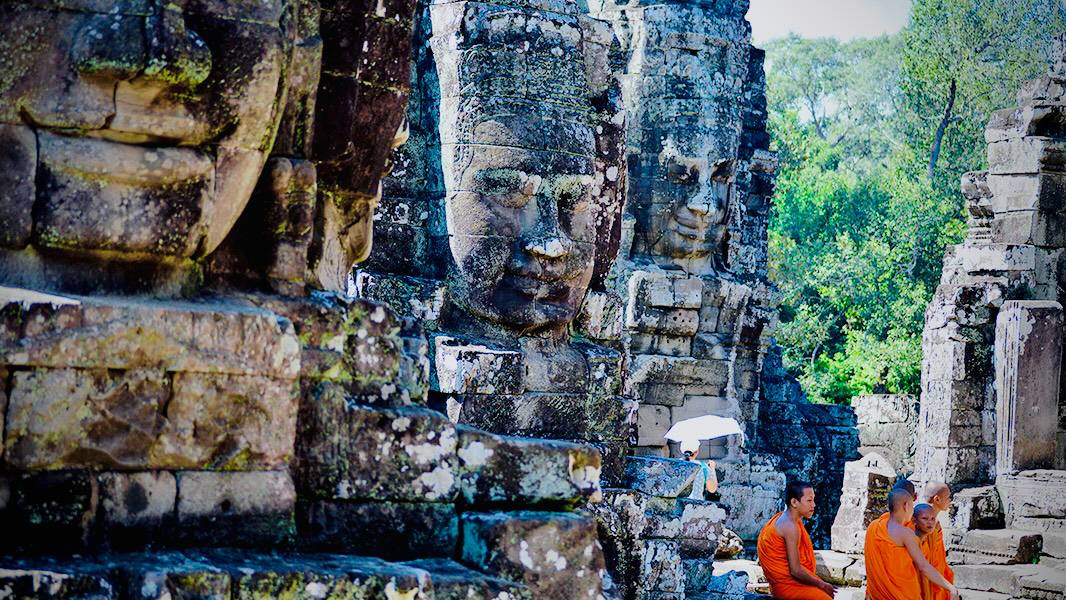
At the heart of ancient Angkor Thom stands Bayon Temple, one of the most extraordinary monuments of the Khmer Empire. Famous for its enormous stone faces, mysterious smiles, and intricate bas-reliefs, Bayon is unlike any other temple in Cambodia.
Built during the reign of King Jayavarman VII in the late 12th or early 13th century, Bayon served as the state temple of Angkor Thom. Its architecture reflects the king’s powerful Buddhist faith, while later modifications reveal the religious and political changes that took place within the Khmer Empire.
Today, Bayon is one of the highlights of any visit to the Angkor Archaeological Park—not simply because of its spectacular towers, but because the temple provides an extraordinary glimpse into Khmer religion, architecture, warfare, everyday life, and royal power.
Where Is Bayon Temple?
Bayon is located almost exactly at the center of Angkor Thom, the enormous walled city built by King Jayavarman VII.
Angkor Thom lies immediately north of Angkor Wat, within the wider Angkor Archaeological Park near Siem Reap. The temple can be reached through one of the city’s monumental gates, with the South Gate being the most commonly used entrance for visitors arriving from Angkor Wat.
The History of Bayon Temple
Bayon was constructed during the reign of Jayavarman VII, one of the most powerful and ambitious rulers in Khmer history.
Jayavarman VII came to the throne around 1181 CE, after a period of conflict and political instability. His reign marked a remarkable period of construction throughout the Khmer Empire.
The king was a devoted Mahayana Buddhist, and he commissioned enormous building projects, including:
- Bayon Temple
- Angkor Thom
- Ta Prohm
- Preah Khan
- Banteay Kdei
- Neak Pean
- numerous roads, bridges, hospitals, and rest houses
Bayon was at the center of this extraordinary building program.
Unlike Angkor Wat, which was originally dedicated to the Hindu god Vishnu, Bayon was primarily associated with Mahayana Buddhism during Jayavarman VII’s reign.
The temple appears to have represented the sacred center of the king’s new capital, Angkor Thom.
The Mystery of the Bayon Faces
The most famous feature of Bayon is undoubtedly its monumental stone faces.
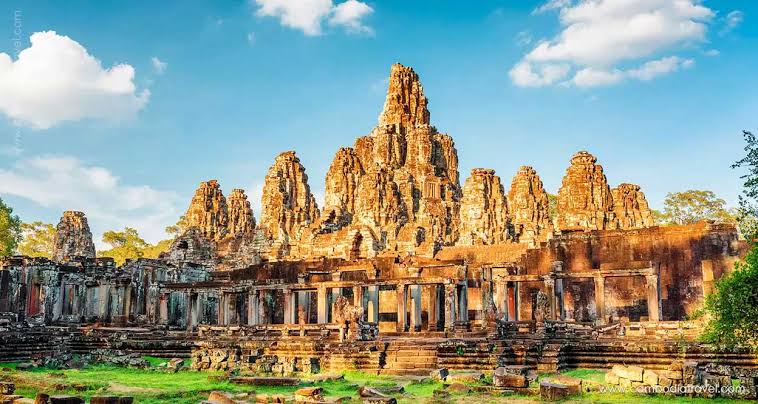
The temple originally contained numerous towers decorated with gigantic faces looking toward the cardinal directions. Today, approximately 37 surviving towers are generally counted within the temple complex, although the exact number of original towers and faces has been debated by scholars.
The faces share remarkably similar characteristics:
- gently closed or lowered eyes
- broad foreheads
- prominent lips
- calm expressions
- elongated ears
- distinctive smiles
The expression has become popularly known as the “Bayon smile.”
Standing among these enormous faces is one of the most memorable experiences at Angkor. From certain locations, several faces seem to look directly at you from different levels of the temple.
Their peaceful expressions create a striking contrast with the massive stone architecture surrounding them.